Wildlife in Lake Mburo National Park
Lake Mburo National Park occupies a distinctive place on Uganda's safari map. At roughly 370 square kilometres, it is the country's most compact savannah national park — far smaller than Queen Elizabeth National Park or Murchison Falls National Park — yet it packs acacia woodland, rolling hills, rocky ridges, wetlands, and five lakes into a landscape that feels classically East African without the long overland drives those larger parks demand. For travelers routing southwest from Kampala toward gorilla trekking or the western wildlife circuit, Mburo is often the first place where zebras and impala appear at close range.
Wildlife viewing here is shaped by ecology and management history. Predator pressure is lower than in parks where lion and leopard dominate the food web, which changes the atmosphere: herbivores graze in open view, walking safaris are viable with armed rangers, and boat cruises on Lake Mburo add a water-level perspective that land-based game drives cannot replicate. That combination makes the park especially rewarding for families, photographers, first-time safari visitors, and anyone who wants active experiences beyond sitting in a vehicle all day.
Zebras and the East African savannah feel
Zebras are the park's most visible signature. Burchell's zebra herds move across grassland and acacia edges in patterns that photographers recognize instantly — striped bodies against golden savannah, often with warthogs, topi, or waterbuck nearby. Because visitor numbers are modest compared with Uganda's headline parks, zebra encounters frequently feel unhurried. Morning and late-afternoon light on the open plains produces some of the strongest landscape-and-wildlife compositions in southwestern Uganda.
Zebras here are not a novelty add-on; they anchor the park's identity as a true savannah destination within a country better known for mountain gorillas and rainforest primates. Travelers who combine Bwindi Impenetrable National Park gorilla trekking with a Mburo stop get a clear before-and-after contrast — forest intimacy one week, open plains the next.
Impala: Uganda's unusual antelope highlight
Impala give Lake Mburo National Park wildlife a uniqueness that serious safari planners notice. Impala occur widely in Kenya and Tanzania but are scarce in most other Ugandan parks, making Mburo the reliable place to tick this elegant antelope on a national itinerary. Mixed herds of impala, topi, eland, bushbuck, oribi, and waterbuck illustrate how acacia woodland and seasonal wetlands support varied grazers and browsers in a relatively small area.
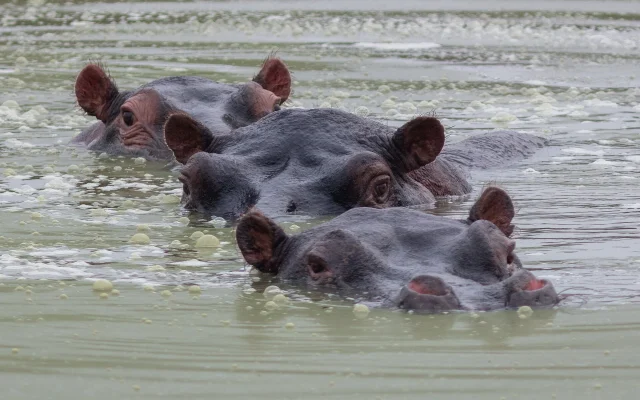
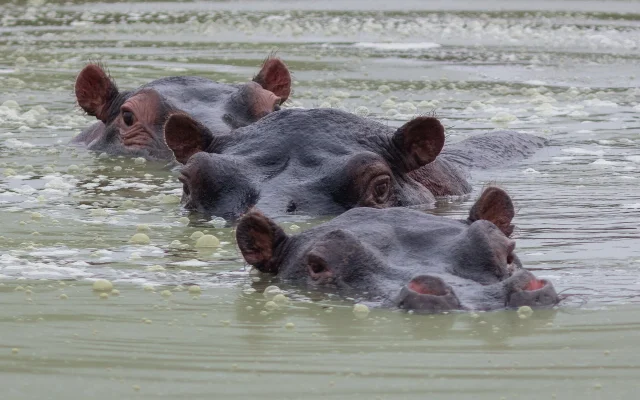
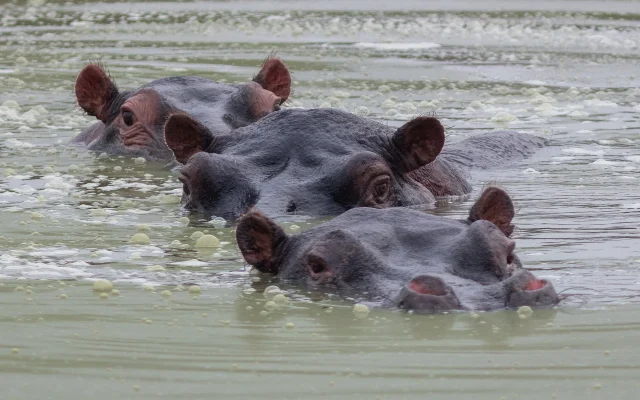
Eland — Africa's largest antelope — also occur in the park, along with Rothschild's giraffe (reintroduced as part of conservation programmes), African buffalo, warthog, and hippopotamus. Crocodiles and hippos connect the terrestrial and aquatic systems; seeing hippos yawning from a boat while zebras graze on a distant ridge is a classic Mburo moment that explains why many operators treat the park as a two-night stop rather than a rushed drive-through.
Predators, scavengers, and realistic expectations
Leopard occur in Lake Mburo National Park but are shy and rarely seen on a standard itinerary. Spotted hyena and side-striped jackal are present; smaller carnivores and raptors fill ecological roles that larger parks showcase through lion prides. Mburo is not where travelers come primarily for big-cat drama — and that is a strength for walking safaris, horseback outings, and relaxed game drives where the emphasis stays on herbivore diversity, birdlife, and scenery.
Compared with Queen Elizabeth, where tree-climbing lions and Kazinga Channel boat cruises headline the experience, Mburo trades predator spectacle for accessibility and activity variety. Many itineraries use Queen Elizabeth for classic big-game breadth and Mburo for zebra–impala intimacy plus walking — complementary chapters, not duplicates.
Boat safaris and lakeshore ecology
A boat safari on Lake Mburo shifts the wildlife narrative to water. Hippos cluster in shallows; Nile crocodiles bask on banks; African fish eagles call from dead trees; herons, kingfishers, cormorants, and storks work the shoreline. Buffalo sometimes drink at the edge; wetland margins hold papyrus specialists that link the park to broader western Uganda birding circuits.
Boat time balances the dust and heat of midday game drives, suits travelers who prefer gentler pacing, and gives families a seated wildlife activity with strong sightlines. It pairs naturally with an early-morning drive for zebras and impala, then an afternoon on the water — a full-day rhythm that fits the park's compact geography without exhausting transfer times between sectors.
Walking safaris and close-to-ground encounters
Walking safaris in Lake Mburo National Park are among Uganda's best supported. An armed ranger and guide lead small groups through acacia woodland and open valleys where tracks, dung, bird calls, and seasonal plants become part of the story. You may approach zebra and impala at respectful distance on foot — an experience vehicle windows cannot replicate. Lower predator density makes this viable; it would be irresponsible in parks where lion encounter risk dominates access rules.
Walking also surfaces details drives skip: termite mounds, francolin alarm calls, the smell of wild sage after rain, and the way impala herds post sentries while others graze. Educational and photographic travelers often rank the walk as their Mburo highlight even when boat and drive sightings were excellent.
Habitats within a small park
Despite its size, Mburo protects a mosaic: acacia woodland, open savannah, rocky kopjes, seasonal wetlands, and permanent lakes. That variety supports the antelope diversity and 350-plus bird species recorded in the wider system. The park sits in Ankole cattle country; surrounding ranch landscapes and the town of Mbarara shape gateway logistics, fuel stops, and cultural context on the Masaka–Mbarara highway corridor.
Conservation history includes gazettement in 1983 and ongoing tension between pastoral livelihoods and park boundaries — a lived-in landscape rather than remote wilderness. Visitors who understand that context appreciate Mburo as a working southwestern Uganda ecosystem, not an isolated reserve.
How Mburo fits a wider Uganda safari
Most travelers reach Mburo by road from Kampala in roughly four to five hours, making it ideal as a first-night savannah stop or a break before longer legs to Bwindi, Mgahinga, or Queen Elizabeth. Igongo Cultural Centre near Mbarara adds Ankole heritage without a major detour. Katonga Wildlife Reserve and Lake Bunyonyi extend the same southwestern arc for birders and scenery seekers.
For deeper planning, see our guides on Lake Mburo National Park bird watching, best time to visit, and getting there — each covers a different angle of the same compact savannah visit.