De brazza’s monkey diet — expert Uganda safari guide from local planners who know permits, parks, and realistic routing.
The De Brazza's monkey diet reflects its swamp-forest lifestyle — a flexible omnivorous menu of fruits, seeds, young leaves, flowers, fungi, and occasional invertebrates gathered from the forest floor and mid-canopy. Unlike the leaf-specialist colobus of Uganda's montane parks, De Brazza's monkeys exploit a broad seasonal palette that shifts as Semuliki's lowland trees and Mount Elgon's montane flora fruit through the year. Understanding what they eat explains when and where patient observers are most likely to find them active along Semuliki stream banks and Mount Elgon gallery margins.
Omnivorous Forest Foraging
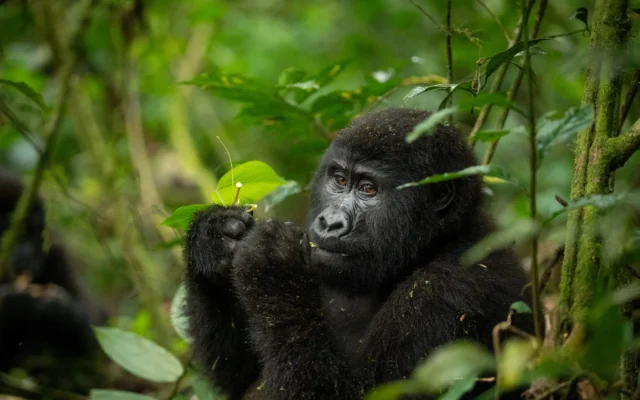
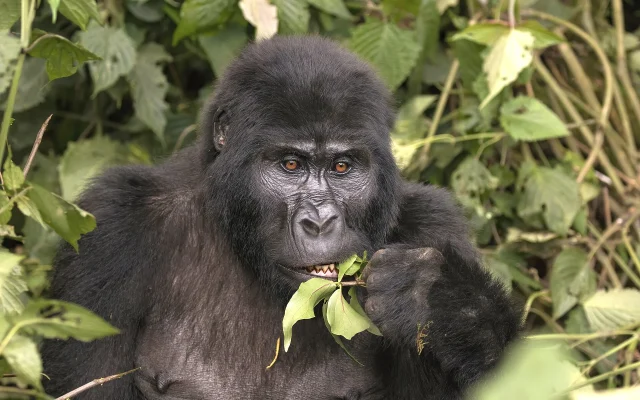
De Brazza's monkeys are generalist forest omnivores — neither strict frugivores like some guenons nor folivorous specialists like colobus. This dietary breadth allows family groups to persist in relatively small territories where seasonal resource availability fluctuates. Foraging is deliberate and quiet: animals pick through leaf litter, pluck fruits from low branches, and probe bark crevices for insects and grubs.
Semi-terrestrial habits distinguish them from more arboreal guenons. Much feeding occurs on the ground within metres of water — a behaviour that increases sighting probability for forest walkers who move slowly and scan ahead of their guide's pace.
Fruits and Seeds
Fruits form the caloric backbone of the De Brazza's diet when available. Lowland Semuliki forest supports diverse tree species with central African affinities — many producing fleshy fruits, drupes, and pods that monkeys consume whole or manipulate to extract seeds. Figs, palm fruits, and forest tree species fruiting at different intervals provide staggered availability through the year.
Seed consumption accompanies fruit feeding. De Brazza's monkeys crack hard seeds with molars adapted for crushing rather than shearing — a dental profile shared with other omnivorous guenons. Some seeds pass through the gut intact, making the species a modest but meaningful dispersal agent for forest trees along swamp corridors.
Seasonal Fruiting Patterns
Although Semuliki remains green year-round, individual tree species follow phenological cycles. Peak fruiting months can draw De Brazza's groups to specific groves — experienced rangers sometimes predict encounter zones based on which trees are dropping fruit. On Mount Elgon, montane forest species follow slightly different calendars, with some fruits peaking during transitional wet periods.
Leaves and Shoots
When fruits are scarce, De Brazza's monkeys increase consumption of young leaves, buds, and tender shoots. Leaf eating is selective — monkeys target new growth with lower fibre and tannin content, stripping shoots from shrubs and saplings along swamp margins. This browse component links them ecologically to vegetation layers that colobus exploit more heavily in the canopy above.
Young leaves provide protein and moisture during dry spells when fleshy fruits diminish. The ability to switch between fruit and foliage reduces starvation risk in small family groups with limited ranging distance.
Flowers and Nectar
Forest flowers contribute sugars and nutrients, particularly from species blooming along stream banks where light penetration is higher. De Brazza's monkeys may consume entire inflorescences or lick nectar from accessible blooms — a minor but seasonally significant dietary component that overlaps with the flower-visiting habits of Semuliki's sunbirds and honeybees.
Fungi and Forest Floor Foods
Mushrooms and other fungi appear in the diet during wet periods when forest-floor fruiting bodies proliferate. De Brazza's monkeys also consume tender herbs, bulbs, and underground plant parts when surface foods decline — behaviour observed in other terrestrial guenons and consistent with their ground-foraging ecology.
Invertebrates and Animal Matter
Although primarily plant-based, De Brazza's monkeys supplement with insects, grubs, snails, and occasional eggs or small vertebrates. Invertebrate foraging intensifies when protein demand rises — during lactation, juvenile growth, or periods of fruit scarcity. Monkeys overturn leaf litter, probe rotting wood, and snatch caterpillars from foliage with quick, precise movements.
This animal component distinguishes them from strict herbivores and aligns with the omnivorous flexibility that characterises successful guenons in variable forest environments.
Water and Foraging Location
Proximity to water shapes foraging geography. De Brazza's monkeys drink from streams and may feed on aquatic-edge plants unavailable in drier forest interior. Swamp margins concentrate both food and moisture — the reason guides focus on riparian trails during where to see excursions in Semuliki.
Unlike savannah species that travel kilometres to waterholes, De Brazza's family groups structure daily movement around permanent water within compact territories — typically stream networks they know intimately across seasons.
Foraging Behaviour and Social Context
Family groups forage cohesively, with the breeding pair and offspring moving in loose coordination. Adults lead juveniles to productive food patches; young animals learn by watching which fruits are peeled, which leaves are rejected, and which bark surfaces harbour grubs. Quiet foraging contrasts with the noisy chattering of red-tailed monkey troops — another reason De Brazza's require patient observation.
When a rich food patch appears — a fruiting fig, for example — the group may remain in the area for extended periods, increasing encounter windows for forest walkers who arrive at the right moment.
Diet Comparison with Other Ugandan Primates
- Black-and-white colobus: Leaf specialists with fermenting gut chambers; rarely eat fruit or insects
- Red-tailed monkey: Frugivorous guenon; more arboreal, less ground foraging
- Chimpanzee: Broad omnivore including meat; large ranging parties and tool use
- De Brazza's monkey: Flexible omnivore; semi-terrestrial; swamp-forest food plants
Ecological Role as Seed Disperser
By consuming fruits and excreting seeds away from parent trees, De Brazza's monkeys contribute to forest regeneration along gallery corridors. Their ranging is limited compared with large frugivores, so dispersal distances are modest — but within small swamp-forest fragments, even short-distance seed transport maintains plant population structure.
Diet and Tourism Timing
Travellers who understand dietary seasonality improve sighting odds. Dawn walks coincide with peak foraging activity as groups leave roosts and move to stream-margin feeding stations. Dry-season months — June to September and December to February — firm forest trails while many tree species continue fruiting on staggered schedules. See best time to see De Brazza's monkey for monthly planning.
Human Impact on Food Resources
Habitat loss removes food trees and severs swamp corridors. Snaring targets ground-foraging animals directly. Cocoa and garden encroachment replaces native forest plants with crops De Brazza's cannot exploit. Conservation that protects swamp-forest habitat simultaneously protects the food web this species depends on — a connection explored further on our conservation page.
Quick Diet Summary
- Primary foods: Fruits, seeds, young leaves, flowers
- Supplementary: Insects, grubs, fungi, occasional animal matter
- Foraging zone: Forest floor and low canopy near water
- Feeding style: Quiet, selective, semi-terrestrial
- Peak activity: Dawn and late afternoon
- Key Uganda sites: Semuliki streams; Mount Elgon gallery forest